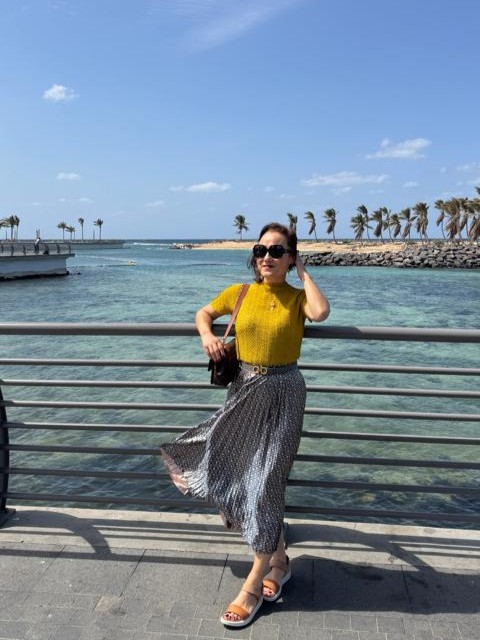
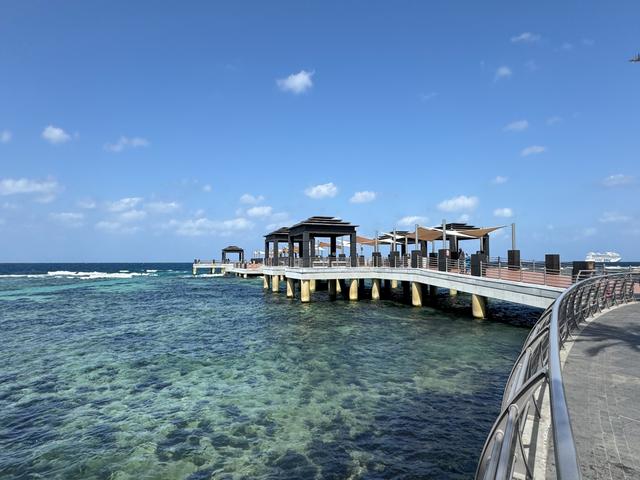
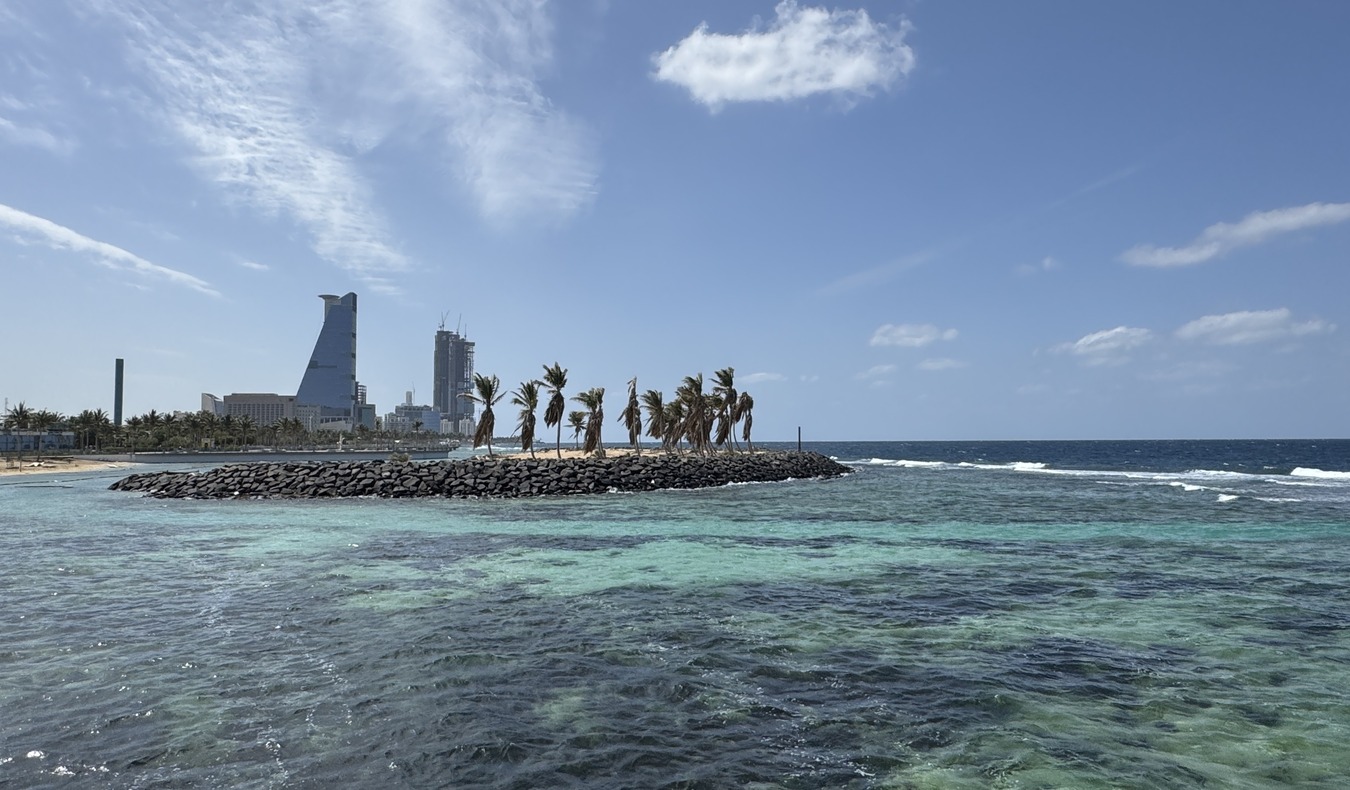
Early in the morning, we headed to the Jeddah Corniche for a walk and some photos. Walking along the coastline, the deep blue waters sparkled under the sun, and clusters of dark seaweed dotted the shallows. Locals told us that when these algae die, they turn reddish-yellow. When they wither in large patches, the sea looks as if it’s veiled in red — hence the name “Red Sea.” The city government has carefully developed this area, building piers that extend into the sea, allowing people to get close to the waves and sea breeze. Palm trees thrive on the small offshore islands, bringing a strong tropical vibe. The scenery felt like a vivid painting. It was a windy day — so windy it instantly blew my hair into a giant puffball. Unintentionally fashionable, I suppose.
Floating Faith
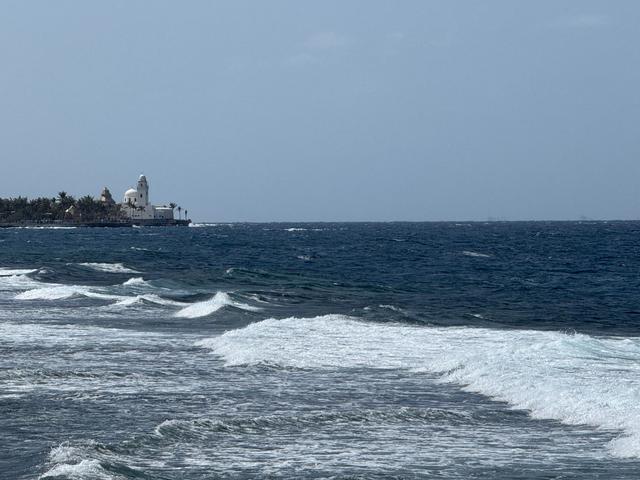
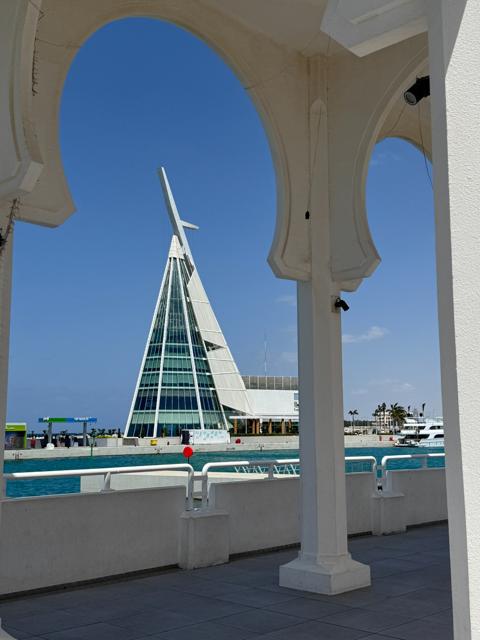
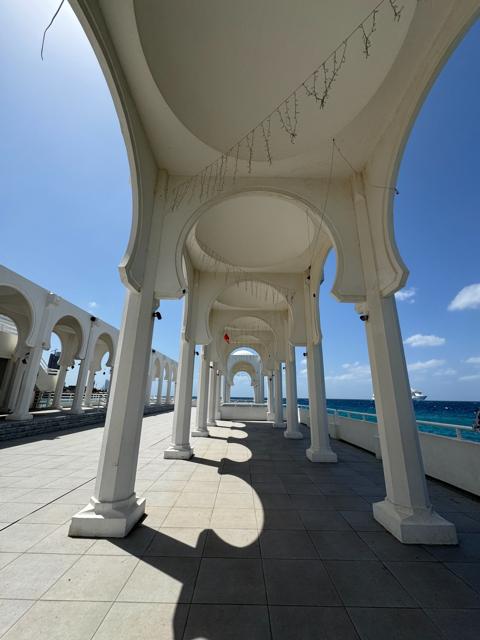
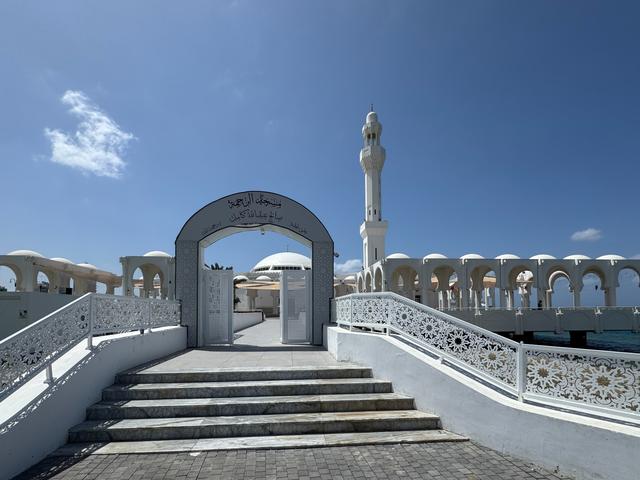
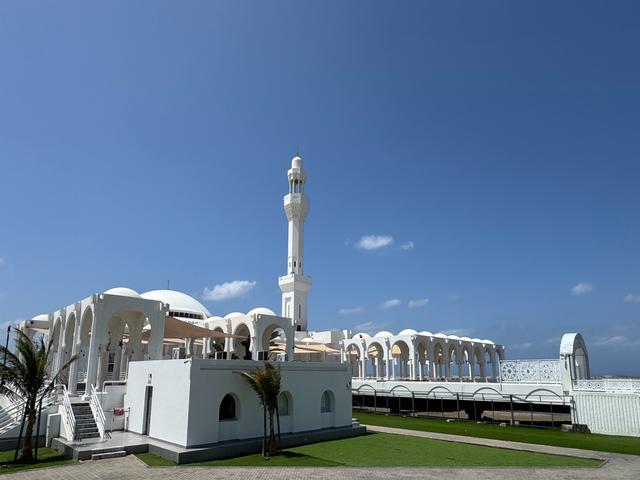
Our next stop was the famous Al Rahma Mosque, often called the “Floating Mosque.” Following Google Maps, the route got a bit tricky near the end, winding around before we finally arrived. There was no designated parking lot nearby — it didn’t quite feel like a tourist attraction. But since we were already there, of course we had to go take a look. The mosque sits right at the shore, supported by rows of concrete pillars deeply embedded into the sea. At high tide, the water covers the base, making the mosque appear to float above the Red Sea. The architecture is elegant, and with the sea as a backdrop, it creates a uniquely serene and spiritual atmosphere. We weren’t sure if the mosque was open; apart from a cleaner, we didn’t see any other visitors. We strolled along the corridor and took photos of the landmark eagle sculpture nearby.
Echoes of the Past
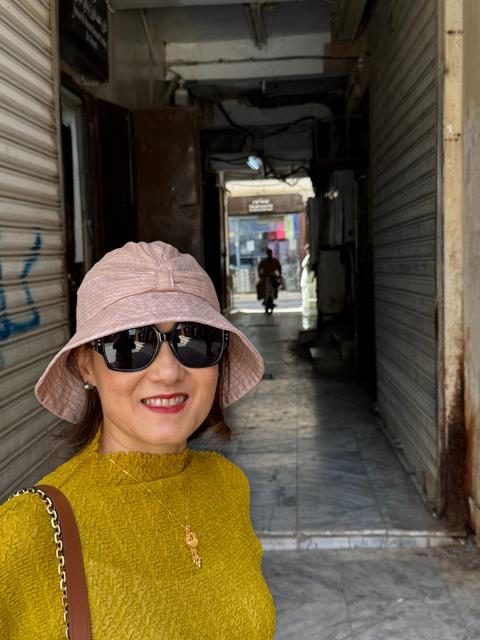
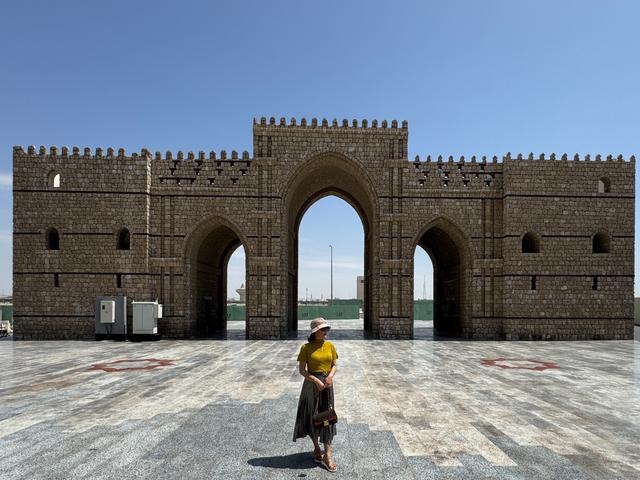
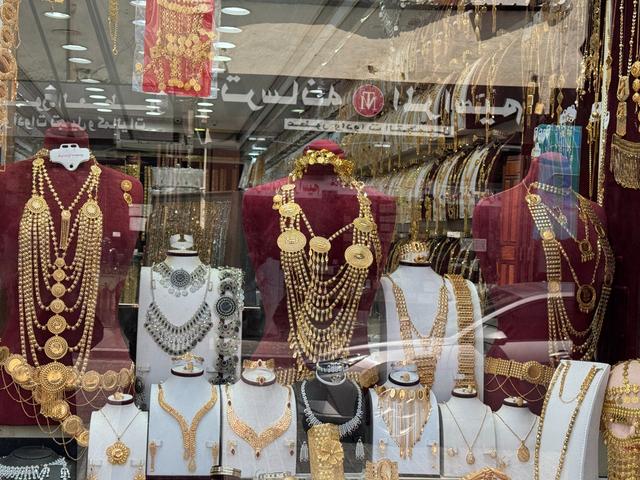
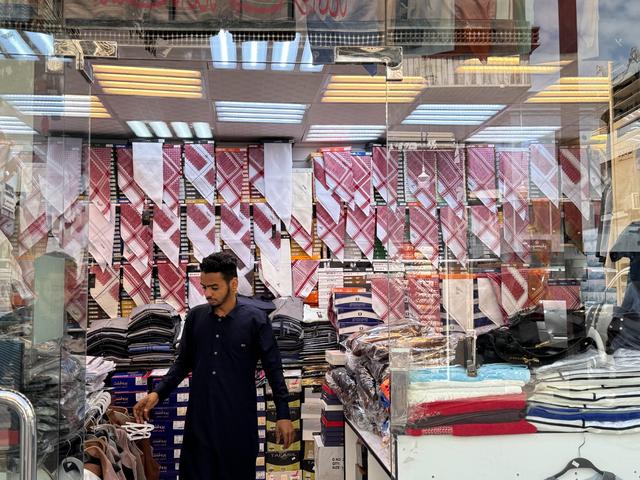
Next, we explored the Old Town. As we approached, the road suddenly disappeared. Google Maps directed us onto a large gravel area. We hesitated, but seeing other cars parked there, we followed suit. Though there were no official parking lines, everyone seemed to instinctively form neat rows. The Old Town is large, but many buildings are run-down. Some are cordoned off and appear to be marked for demolition. While walking, a local man approached us for a chat. I asked if the area was being demolished. He explained that some buildings were being torn down, while others were undergoing restoration. He runs a shoe shop across the street but lives in the new part of the city. One iconic landmark here is Bab Makkah, the Gate of Mecca. It’s said that in the past, pilgrims departed for Mecca from this very spot. Though modern transport has made this unnecessary, the gate remains, beautifully preserved and restored. Nearby construction suggests that a new cultural center might be in development, as the entrance bears a sign from the Ministry of Culture. Strolling the streets here, you can sense everyday life. The wooden lattice windows, typical of Arabian style, are everywhere. Every few steps, we spotted a gold shop — a testament to the region’s love for gold. A fun little discovery: men’s keffiyehs (headscarves) actually come in different patterns! I used to think they were all the same — clearly, I was mistaken.
One iconic landmark here is Bab Makkah, the Gate of Mecca. It’s said that in the past, pilgrims departed for Mecca from this very spot. Though modern transport has made this unnecessary, the gate remains, beautifully preserved and restored. Nearby construction suggests that a new cultural center might be in development, as the entrance bears a sign from the Ministry of Culture.
Strolling the streets here, you can sense everyday life. The wooden lattice windows, typical of Arabian style, are everywhere. Every few steps, we spotted a gold shop — a testament to the region’s love for gold. A fun little discovery: men’s keffiyehs (headscarves) actually come in different patterns! I used to think they were all the same — clearly, I was mistaken.
Nassif House
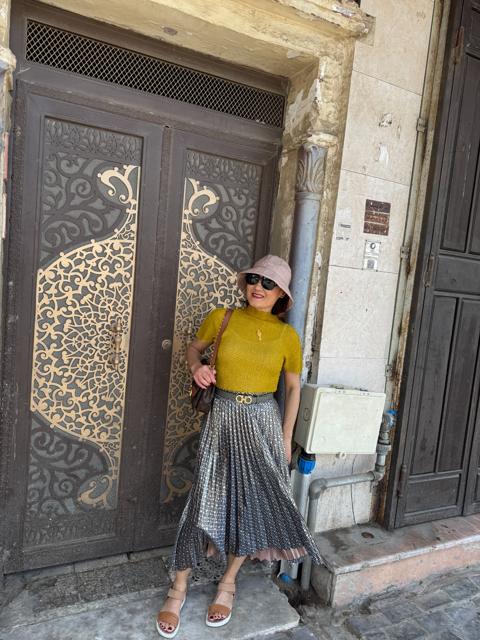
Another stop in the Old Town was the Nassif House Museum. This was once the private residence of the influential Nassif family, known for their political and economic prominence. It’s said that King Abdulaziz, the founder of modern Saudi Arabia, once stayed here. We were excited to visit — but unfortunately, it was closed when we arrived, with no signs or explanations. We took photos outside instead. Even from the exterior, the building speaks of history: beige stone walls, dark wooden windows, and intricate carvings showcase the traditional architectural charm of Old Jeddah.
A Nighttime Aria
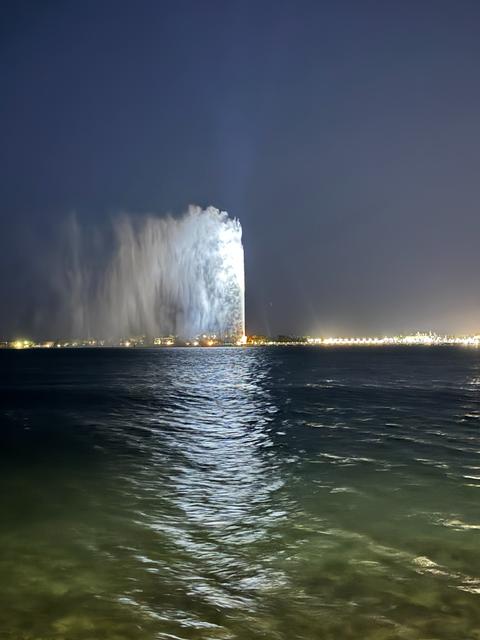
After dinner, we returned to the Corniche to see one of Jeddah’s most iconic sights — the King Fahd Fountain. Gifted by the late King Fahd, the fountain symbolizes the city’s energy and openness. Located by the Red Sea, it shoots water up to 260 meters high, making it the tallest sea fountain in the world. Its water comes directly from the Red Sea. Though the supply is infinite, I imagine the real challenge lies in keeping the salt from clogging the pipes. This is clearly a tourist hotspot — police were directing traffic, and crowds of visitors relaxed on the grass, waiting for the show. We chose to visit at night. Under the lights, the towering white jet of water pierced the sky like a giant silver sword. It was breathtaking.
Closing Thoughts
We only spent one day in Jeddah, and we’re leaving tomorrow. Though short, our visit left a deep impression. This city is changing — growing, developing, and shaping its identity as a travel destination. From the historic texture of the Old Town to the modern coastal charm, Jeddah blends the past with the future. I hope to return one day and see an even more vibrant and captivating Jeddah!
🌍 What’s Next?
On Day 20, we travel from the coastal buzz of Jeddah to the sacred calm of Madinah, one of Islam’s holiest cities. While many religious sites are closed to non-Muslims, we’ll still explore key landmarks like Masjid Dhul Hulayfah (Miqat Mosque), Quba Mosque, and the dramatic landscape of Mount Uhud. It’s a day of quiet reflection and cultural learning in a city rich with spiritual meaning.
We use cookies to ensure that we give you the best experience on our website. If you continue to use this site we will assume that you are happy with it.