Middle East Travel Journal Day 28: Diriyah – The Birthplace of a Nation
Highlights of the Day
Today in Riyadh, we traced the deep historical roots of Saudi Arabia at Diriyah, conversed with locals, explored ancient ruins, ascended one of the city’s tallest tower Kingdom Centre Tower, and met inspiring fellow travelers. It was a day where past and present, tradition and transformation, all came together.
Diriyah is known as “the birthplace of Saudi Arabia,” and is considered one of the most historically and culturally significant places in the country.
Entry to the old town is free—you just need to scan a QR code and register.
What struck me was how beautifully the area blends the old with the new. Inside the At-Turaif Visitor Center, there’s a massive digital screen—perhaps over 10 meters long—loops through Saudi history starting from the year 400. It features the migration of the Banu Hanifa tribe, the founding of the First Saudi State, and Diriyah’s modern redevelopment plans.
Bottled water was thoughtfully provided throughout the visitor center, and we later discovered that this hospitality extended to all exhibition areas. While we were there, a staff member came over and began explaining Saudi history in great detail.
A Brief History of Three Saudi States
Saudi Arabia’s first state began in 1727 in Diriyah but was destroyed by the Ottomans. The second, based in Riyadh, later fell to the House of Rashid. In 1921, Abdulaziz Ibn Saud unified the region, founding the modern kingdom now led by Crown Prince Mohammed bin Salman (MBS).
A Conversation with a Local Woman
Our guide at the center was a woman wearing a headscarf but not a face veil. Curious, I asked whether it’s now common in Saudi Arabia for women not to cover their faces. She explained that it’s completely a personal choice now. She only wears a headscarf at work; after hours, she doesn’t even wear that.
She asked where we were from, and when she heard we live near New York, her eyes lit up. She said she dreams of visiting New York one day. It’s a pity we didn’t exchange contact information—who knows, maybe we’ll run into each other there someday.
I also noticed how much more relaxed Riyadh feels in terms of religious dress. Many young Saudi women were wearing colorful dresses or abayas in various shades and styles. The difference was striking.
Najdi Architecture and Historic Ruins
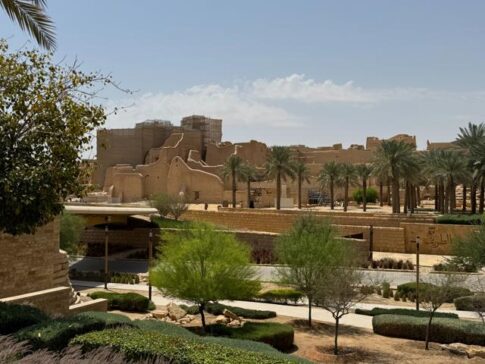
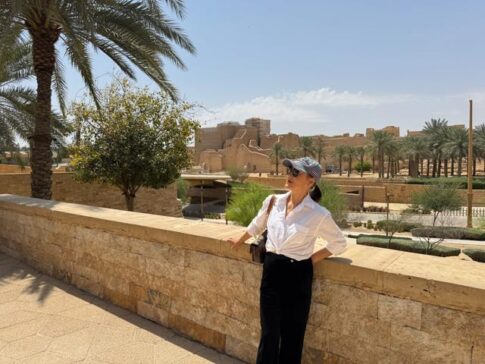
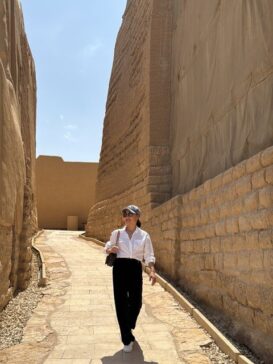
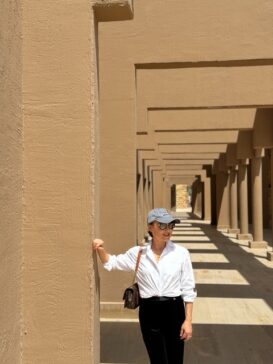
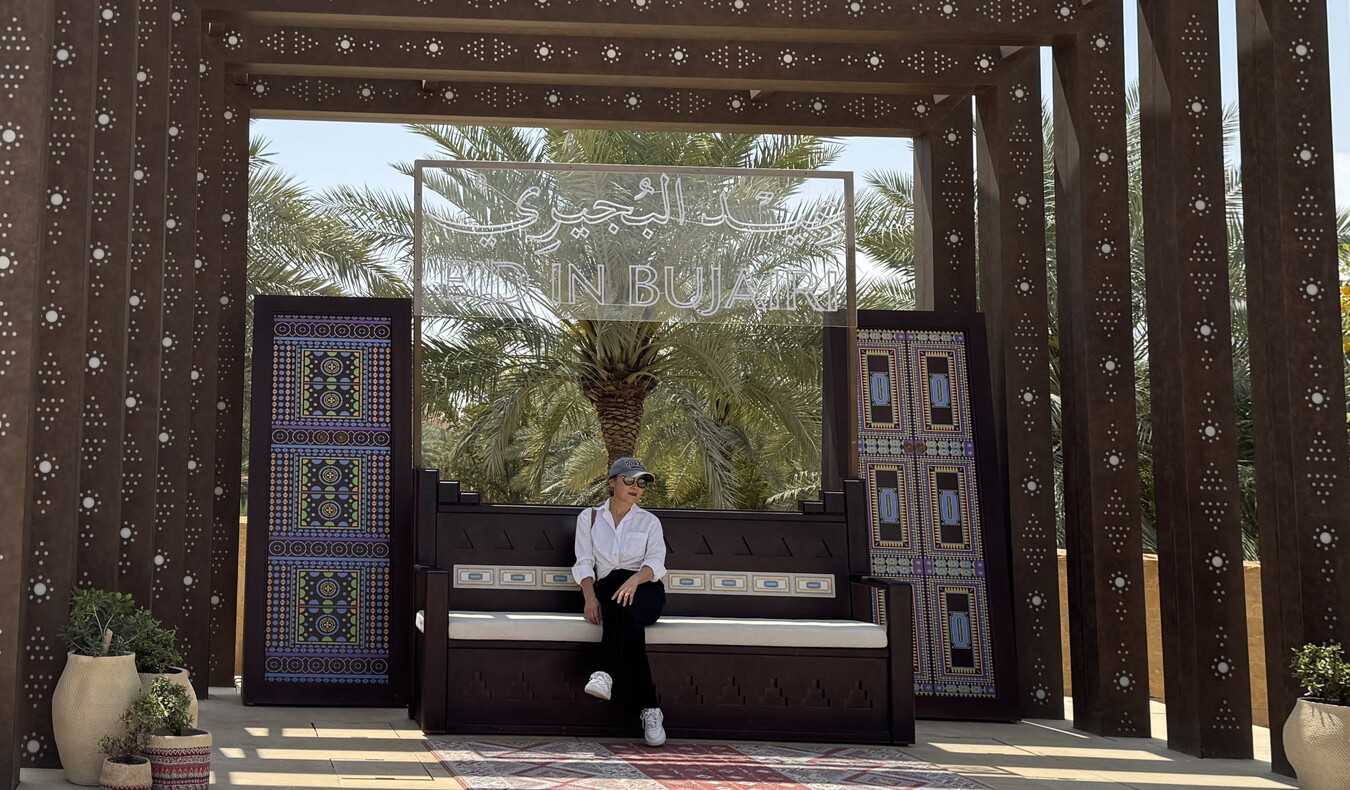
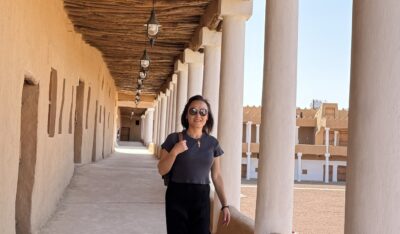
Exiting the visitor center, we walked into a neighborhood full of traditional Najdi-style architecture—the same type we saw earlier in AlUla. These structures are built with mud bricks, featuring thick walls, watchtowers, and arched doorways. Simple yet defensive, they reflect the local desert culture.
Along the way, we passed an ancient well, the remains of the Imam Mohammed bin Saud Mosque (now only foundation columns remain), and the ruins of the royal residence. All of these landmarks paint a vivid picture of the political and religious life during the First Saudi State.
Lunch Detour: Back to Jiangnan Pavilion
For lunch, we planned to try a nearby Chinese restaurant called He Shufang, but found it closed for unknown reasons. After asking around with no clear answer, we decided to return to Jiangnan Pavilion, the Chinese place we ate at the day before.
Kingdom Centre Tower & Sky Bridge Views
After lunch, we headed to the iconic Kingdom Centre Tower. From afar, the skyscraper stands out with its sleek design. The building has 99 floors, topped with a massive inverted triangle. The horizontal structure at the top is the famous Sky Bridge. The shape reminds me a lot of the Shanghai World Financial Center—nicknamed “the beer bottle opener handle.” It’s an unforgettable design.
At the ticket counter, we saw two Chinese-speaking women struggling to communicate with the staff. I stepped in to help, and they were delighted. We ended up touring the Sky Bridge together.
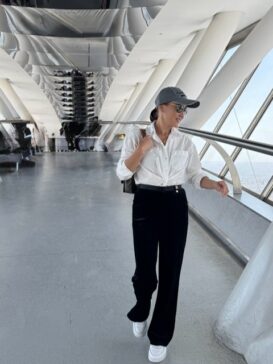
The Sky Bridge spans across the top of the tower, suspended high above the city. A glass floor beneath our feet added a slight thrill as we crossed.
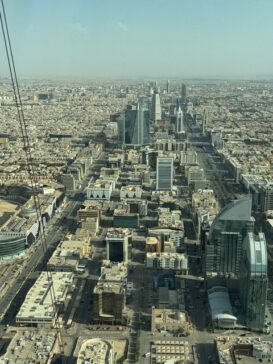
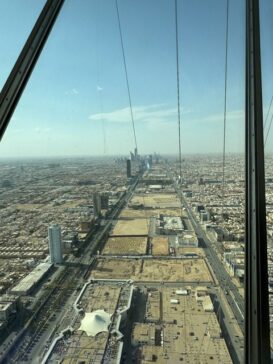
Standing in the center, we took in a panoramic view of Riyadh bathed in sunlight. One side of the main boulevard was lined with tall buildings; the other was still under heavy construction. It reminded me of Shanghai’s Pudong district during its development boom 30 years ago.
A Sweet Surprise and an Inspiring Encounter
When we bought our tickets, we were told to stop by a nearby mall afterward to claim a gift. To our surprise, it was a cup of frozen yogurt. We sat together, happily chatting as we enjoyed our treat.
Our new companions were from mainland China, doing business in Riyadh in fireproof materials. Since it was Ramadan, and locals weren’t working much, they were also taking time off to explore. They said it felt similar to how foreigners once seized the moment to enter China during its reform era. Now, they were doing the same in Saudi Arabia’s era of opening up.
I truly admired their courage. Despite language barriers, they came to this new land to pursue their goals and dreams. So much respect!
🌍 What’s Next?
On Day 29, we return to the modern pulse of Riyadh to explore the capital’s heritage gems—from the formidable Masmak Fortress to the elegant Al-Murabba Palace. At the National Museum, we’ll trace the Kingdom’s sweeping history, before wrapping up the day with reflections on how far we’ve traveled—both in miles and meaning.
If you’d like to learn more about the itinerary, please click the button below to download a free copy of the customizable itinerary.
We use cookies to ensure that we give you the best experience on our website. If you continue to use this site we will assume that you are happy with it.